The Ground Beneath the "I"

There is an I you feel. Located, bounded, looking out at the world from somewhere behind your eyes. Geneosophy is not interested in that I. It is interested in what makes that I possible, the generative ground beneath perception, beneath experience, beneath the very distinction between inside and outside. This is XI, the eXtended I. You cannot feel it. You cannot introspect it. Every act of introspection is already its product.
[Part 1] | [Part 2] | [Part 3] | [Part 4] | [Part 5] | [Part 6]
Practitioner: Everything you've said about Geneosophy, creative autonomy, generating concepts rather than relating them, I can almost imagine a research program around that. Difficult, maybe decades away. But imaginable. What I still don't see is what the object of study is. Neuroscience studies neurons. Computer science studies computation. Linguistics studies language. What does Geneosophy study?
Philosopher: It studies XI which stands of eXtended I.
Practitioner: Which is?
Philosopher: Not the I you feel. You are aware of yourself, a located, bounded subject with thoughts and perceptions and a sense of being here, inside, looking out. That felt I is real. But it is downstream of something. Something that was already working before you became aware of it, that continues working beneath any act of awareness.
Practitioner: The unconscious?
Philosopher: No. The unconscious, in the usual sense, is still content, repressed memories, hidden drives, implicit associations. It is still inside. XI is not inside. It is the condition for there being an inside at all. The generative ground beneath the distinction between inner and outer, between subject and object. Between mind and body. You do not feel XI. You cannot introspect it. Every act of introspection is already its product.
Practitioner: Then how do you study something you can't feel, let alone observe?
Philosopher: The same way physics studies the conditions for observable phenomena. You study the structure of what it produces. But in the case of XI, not the structure as an actuality of concepts, but the condition of possibilities for there being concepts. You study how experience varies across organisms, across development, across pathology, across culture. You ask: what must be true of the generative ground for this particular form of experience to be possible? You work backward from the river to reconstruct the source.
Practitioner: And AI is what, in this picture?
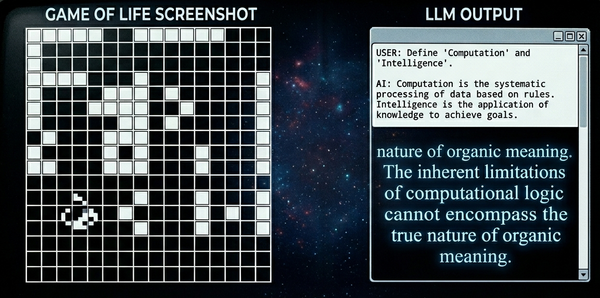
Philosopher: AI is an extraordinarily sophisticated map of the river. It has learned the patterns of the water, its eddies, its currents, its predictable behaviors, with a precision no human cartographer could match. And because the map is so detailed, it is tempting to say: the map is the river. Or worse, the river is just what the map describes.
Practitioner: And the source dries up unremarked.
Philosopher: Or is actively forgotten. Which is the danger you put so precisely: the danger is not that AI will fail. It is that it will succeed. That it will produce outputs indistinguishable from intelligence, and we will conclude that intelligence is what it produces. That we will define humanity downward to fit the model. And in doing so, we will have abandoned the study of XI, the one inquiry that points toward a full understanding of human nature, because we mistook its products for itself.
Practitioner: (quietly) And Geneosophy is the insistence that the source exists.
Philosopher: That the source exists. That it is comprehensible, even if slowly, even if the methods are not yet fully formed. And that the study of it is not a luxury, not philosophy in the pejorative sense you used earlier. It is the most urgent inquiry available. Because everything else we build rests on it. Including, and especially, the machines that are tempting us to stop asking.